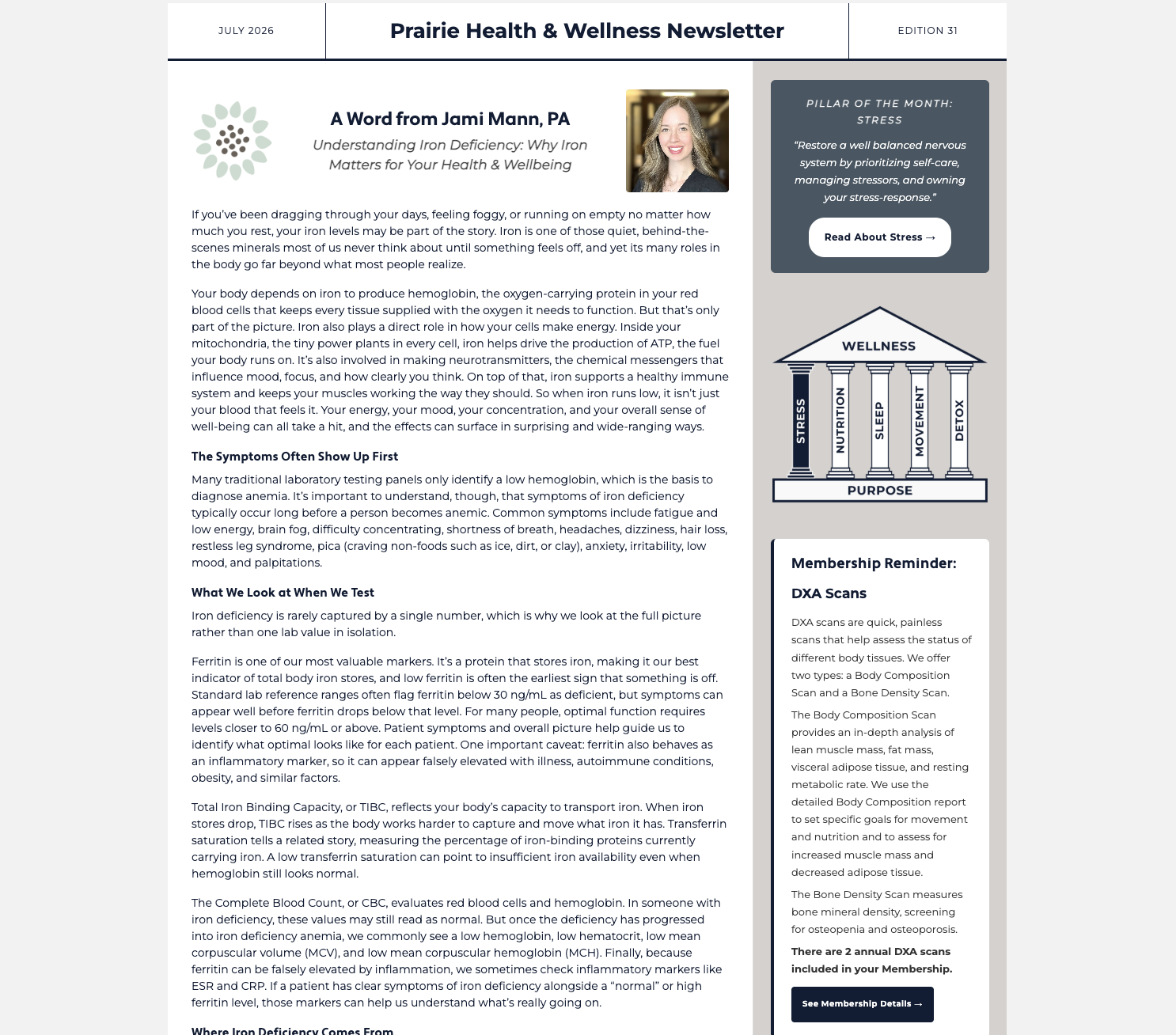


Your body depends on iron to produce hemoglobin, the oxygen-carrying protein in your red blood cells that keeps every tissue supplied with the oxygen it needs to function. But that’s only part of the picture. Iron also plays a direct role in how your cells make energy. Inside your mitochondria, the tiny power plants in every cell, iron helps drive the production of ATP, the fuel your body runs on. It’s also involved in making neurotransmitters, the chemical messengers that influence mood, focus, and how clearly you think. On top of that, iron supports a healthy immune system and keeps your muscles working the way they should. So when iron runs low, it isn’t just your blood that feels it. Your energy, your mood, your concentration, and your overall sense of well-being can all take a hit, and the effects can surface in surprising and wide-ranging ways.
The Symptoms Often Show Up First
Many traditional laboratory testing panels only identify a low hemoglobin, which is the basis to diagnose anemia. It’s important to understand, though, that symptoms of iron deficiency typically occur long before a person becomes anemic. Common symptoms include fatigue and low energy, brain fog, difficulty concentrating, shortness of breath, headaches, dizziness, hair loss, restless leg syndrome, pica (craving non-foods such as ice, dirt, or clay), anxiety, irritability, low mood, and palpitations.
What We Look at When We Test
Iron deficiency is rarely captured by a single number, which is why we look at the full picture rather than one lab value in isolation.
Ferritin is one of our most valuable markers. It’s a protein that stores iron, making it our best indicator of total body iron stores, and low ferritin is often the earliest sign that something is off. Standard lab reference ranges often flag ferritin below 30 ng/mL as deficient, but symptoms can appear well before ferritin drops below that level. For many people, optimal function requires levels closer to 60 ng/mL or above. Patient symptoms and overall picture help guide us to identify what optimal looks like for each patient. One important caveat: ferritin also behaves as an inflammatory marker, so it can appear falsely elevated with illness, autoimmune conditions, obesity, and similar factors.
Total Iron Binding Capacity, or TIBC, reflects your body’s capacity to transport iron. When iron stores drop, TIBC rises as the body works harder to capture and move what iron it has. Transferrin saturation tells a related story, measuring the percentage of iron-binding proteins currently carrying iron. A low transferrin saturation can point to insufficient iron availability even when hemoglobin still looks normal.
The Complete Blood Count, or CBC, evaluates red blood cells and hemoglobin. In someone with iron deficiency, these values may still read as normal. But once the deficiency has progressed into iron deficiency anemia, we commonly see a low hemoglobin, low hematocrit, low mean corpuscular volume (MCV), and low mean corpuscular hemoglobin (MCH). Finally, because ferritin can be falsely elevated by inflammation, we sometimes check inflammatory markers like ESR and CRP. If a patient has clear symptoms of iron deficiency alongside a “normal” or high ferritin level, those markers can help us understand what’s really going on.
Where Iron Deficiency Comes From
Understanding the source matters, because treating low iron without addressing why it dropped in the first place tends to send people right back where they started.
There are four main causes. The most common is blood loss, which can happen through heavy menstrual bleeding, gastrointestinal bleeding, frequent blood donation, or trauma and surgery. The second is increased iron requirements, since certain life stages demand more iron than usual, including pregnancy, breastfeeding, adolescence, and periods of rapid growth. The third is inadequate dietary intake, which develops when what you eat simply doesn’t meet your body’s needs and puts vegans, vegetarians, and those following restrictive diets at higher risk. And the fourth is poor absorption. Even with plenty of iron in the diet, the body can struggle to take it in when there are gut infections (including SIBO), celiac disease, inflammatory bowel disease, gastric bypass, or chronic use of acid-suppressing medications.
This is exactly why we take a two-pronged approach. On one side, we work to find and address the root cause, whether that’s ongoing blood loss, an absorption issue, or a gap in the diet. On the other, we work to rebuild your storage levels so your body has the reserves it needs. Replacing iron without solving the underlying cause is like filling a bucket with a hole in the bottom. We want to patch the hole and fill the bucket.
How We Approach Treatment
Let’s set expectations honestly, because this is one of the most important parts of the conversation. Many people start to feel somewhat better within a few weeks of starting treatment, but truly restoring your iron stores is a slower process that often takes several months. That timeline can stretch even longer if there’s an absorption problem or ongoing blood loss in the picture. Knowing that up front helps the journey feel less discouraging, because progress with iron is real, it’s just gradual. The good news is that we have several options to draw from, and they can work well together or on their own.
Diet
We often begin with diet as the foundation. It’s important to know which foods are iron rich. Heme iron, the form found in animal foods, is the most readily absorbed, and that includes beef, lamb, and liver. Non-heme iron, which comes from plants, is found in foods like beans, lentils, tofu, spinach, and pumpkin seeds. Wherever you’re starting from, your provider and care team can help you build an iron-rich plan that fits your lifestyle. Our Iron Boost Cookbook is also a great place to find simple, iron-rich recipes to get you started.
Oral Iron Supplements
When supplements are needed, there are a few directions we can take. Traditional iron salts (ferrous sulfate, ferrous fumarate, and ferrous gluconate) are the most commonly prescribed because they’re inexpensive and the most studied, but they frequently cause hard-to-tolerate side effects like constipation, abdominal pain, and nausea. Iron bisglycinate, a chelated form of iron, offers significantly fewer GI side effects and excellent absorption, though it tends to be more expensive.
How often you take iron matters too, and the research has shifted over time. Iron has traditionally been prescribed one to three times daily, but newer research is challenging that approach thanks to a better understanding of hepcidin. Hepcidin is the primary regulator of iron absorption, almost like a gatekeeper that controls how much iron enters the blood. When hepcidin levels rise, iron absorption goes down, and studies have shown that taking oral iron causes a temporary spike in hepcidin. After roughly 24 to 48 hours those levels fall and absorption improves, which is why we now know it may be more effective to dose oral iron every other day. There’s a nice bonus to this approach: spacing out your doses often eases the GI upset that makes daily iron so hard to stick with, so you’re more likely to actually keep taking it. To get the most from each dose, take it with vitamin C or with citrus fruits, berries, peppers, or tomatoes, and keep iron separated from calcium-containing products, antacids, and dairy by at least two hours.
One honest note about oral iron: because it works gradually, it can take many months to meaningfully raise your ferritin, especially if absorption is impaired or you’re still losing blood faster than you can replace it. For some people, that slow climb is perfectly fine. For others, it’s worth talking with your provider about whether a faster starting point makes sense.
Transdermal Iron
If you’ve ever tried oral iron supplements and struggled with nausea, constipation, or an upset stomach, you’re not alone. GI side effects are one of the most common reasons people stop taking iron altogether. That’s where transdermal iron comes in. Transdermal iron is a form you apply directly to your skin as a patch or lotion, where it absorbs into your bloodstream over time. Because it bypasses your digestive tract entirely, it delivers iron without the stomach upset that oral supplements can cause. This makes it a great fit for patients with sensitive digestion, gut conditions like Crohn’s or celiac disease, or anyone who simply hasn’t tolerated oral iron well in the past.
Compared to IV iron, which is highly effective but requires an in-office infusion, transdermal iron is something you can use consistently at home. That makes it a more accessible option for ongoing maintenance and mild-to-moderate deficiency. It does work more gradually than IV therapy, so it’s best suited for patients who need steady, long-term support rather than rapid repletion. As always, we’ll use your labs to help determine which form of iron is the right fit for where you are in your health journey, because getting that approach right makes all the difference.
Iron IV
For some patients, oral iron isn’t enough, or it simply works too slowly for what their body needs. Modern intravenous (IV) iron formulations can restore iron stores much more quickly than oral therapy, and an IV can act as a jump-start, getting your levels up faster while we continue to address the root cause. At PHW, iron infusions are often considered when a patient is symptomatic and ferritin falls below optimal levels. This is particularly true when faster repletion is warranted, oral iron hasn’t been effective, or absorption is a concern.
It’s also fair to talk openly about what an iron IV involves, because it’s a real commitment. Initial iron infusions take about three hours and subsequent infusions about one hour. It’s also a financial commitment, so when a provider recommends a series of two or three infusions, that adds up to a meaningful investment of both time and money. We’d rather have that conversation honestly up front than have you feel surprised later. If the cost or time gives you pause, that’s completely understandable, and you’re not stuck. We can support you in monitoring your ferritin after an infusion and work with your provider to explore other forms of supplementation that fit your life and your budget. The goal is always to find the path you can realistically commit to.
When Do We Recommend IV Iron — and Why?
When it comes to choosing between oral and IV iron, we’re looking at the full picture of your labs and how you’re feeling, not just one number in isolation. Generally speaking, if your ferritin is very low (often under 30 ng/mL, and especially under 15 ng/mL), you’re experiencing significant symptoms like crushing fatigue, hair loss, shortness of breath, or heart palpitations, or your levels simply aren’t moving despite weeks of consistent oral supplementation, IV iron becomes a much more compelling option. IV iron delivers a concentrated dose directly into the bloodstream, bypassing any absorption barriers in the gut entirely, which means faster and more reliable repletion. We also tend to recommend it when there’s an underlying reason your gut isn’t absorbing iron well, whether that’s a digestive condition, low stomach acid, or a history of GI surgery. Think of it this way: oral iron is like filling a bathtub one cup at a time, while IV iron is turning on the faucet. Both get the job done, but when the tub is very empty and you’re not feeling well, speed and reliability matter.
Why Iron Levels Can Drop Again — and What That Means for You
One of the most common questions we hear after a successful course of IV iron is: “Why did my levels fall again?” The honest answer is that iron repletion is often an ongoing process, not a one-time fix, and understanding why can make the journey feel a lot less frustrating. Iron deficiency rarely happens in a vacuum. It usually has a root cause: heavy menstrual cycles, poor dietary intake, chronic inflammation, gut absorption issues, or increased demand during pregnancy or intense exercise. If that underlying cause hasn’t fully resolved, iron stores will gradually deplete again over time even after treatment. Think of IV iron as restoring your reserves, not fixing the leak. This is exactly why we track ferritin regularly and why your care plan may include periodic infusions, ongoing oral or transdermal iron, dietary support, or continued investigation into what’s driving the loss in the first place. Keeping ferritin in a healthy range (we typically aim for 60–100 ng/mL for optimal energy, hair health, and overall function) is a long game for many patients, and that’s okay. You’re not failing; your body is telling us something important, and we’re listening.
Closing Thoughts
Iron deficiency is common, often overlooked, and very treatable once it’s identified, but it can also be persistent. Keeping your levels up over time takes patience and a bit of partnership, and that’s okay. The encouraging part is that you don’t have to navigate any of it alone. By paying attention to early symptoms, looking deeper than a single lab value, addressing the root cause, and finding the approach that fits your body and your life, you can rebuild your reserves and start feeling like yourself again. If any of this sounds familiar, talk with your provider and care team. We’re here to help you get to the root of it and build a plan that moves you forward.